Strengthening Maternal Health Through Digital Learning Infrastructure in Ethiopia

The Story Behind the Intervention
In a regional Ethiopian community center, a young midwife named Hana begins her shift before sunrise. She serves dozens of mothers each week. Some travel hours on foot. Many arrive late in labor. Complications are not rare.
Hana has received training. She has attended workshops. She has read printed manuals. Yet when a postpartum hemorrhage case occurs, confidence depends not on attendance but on mastery.
This is where structured learning becomes life-saving.
The community center recognized that improving maternal outcomes required more than periodic training sessions. It required a system: one that could standardize competencies, track mastery, reinforce emergency scenarios, and scale beyond one location.
To address this, the center implemented GEOR Learn, a digital learning platform designed for regulated, high-stakes sectors.
The objective was clear:
Create measurable, scalable, and accountable maternal health training infrastructure capable of strengthening professional readiness across diverse Ethiopian contexts.
The Intervention Model
The project transformed fragmented vocational training into a digitally governed learning ecosystem built on four pillars:
1. Structured Competency Pathways
Maternal health curricula were mapped into sequenced digital learning tracks covering:
- Antenatal care standards.
- Safe delivery protocols.
- Emergency obstetric response.
- Neonatal resuscitation.
- Postnatal monitoring.
Each learner now follows a defined pathway aligned with national healthcare standards.
2. Simulation-Based Microlearning
High-risk obstetric scenarios were converted into short, mobile-friendly modules. These include:
- Postpartum hemorrhage response.
- Hypertensive crisis management.
- Neonatal stabilization procedures.
Trainees can rehearse critical decisions repeatedly, even in low-bandwidth rural environments.
In high-stakes healthcare settings, repetition builds reflex.
3. Automated Competency & Certification Tracking
The platform introduced:
- Assessment thresholds tied to competency validation.
- Supervisor dashboards.
- Recertification reminders.
- Audit-ready digital certification records.
Training is no longer attendance-based. It is outcome-based.
4. Responsible Data Governance
Role-based access control, encrypted learner records, and structured data retention policies ensure ethical and secure management of professional training data.
In regulated healthcare sectors, governance builds trust.
Measurable Impact to Date
Within the initial implementation cycle, the center recorded:
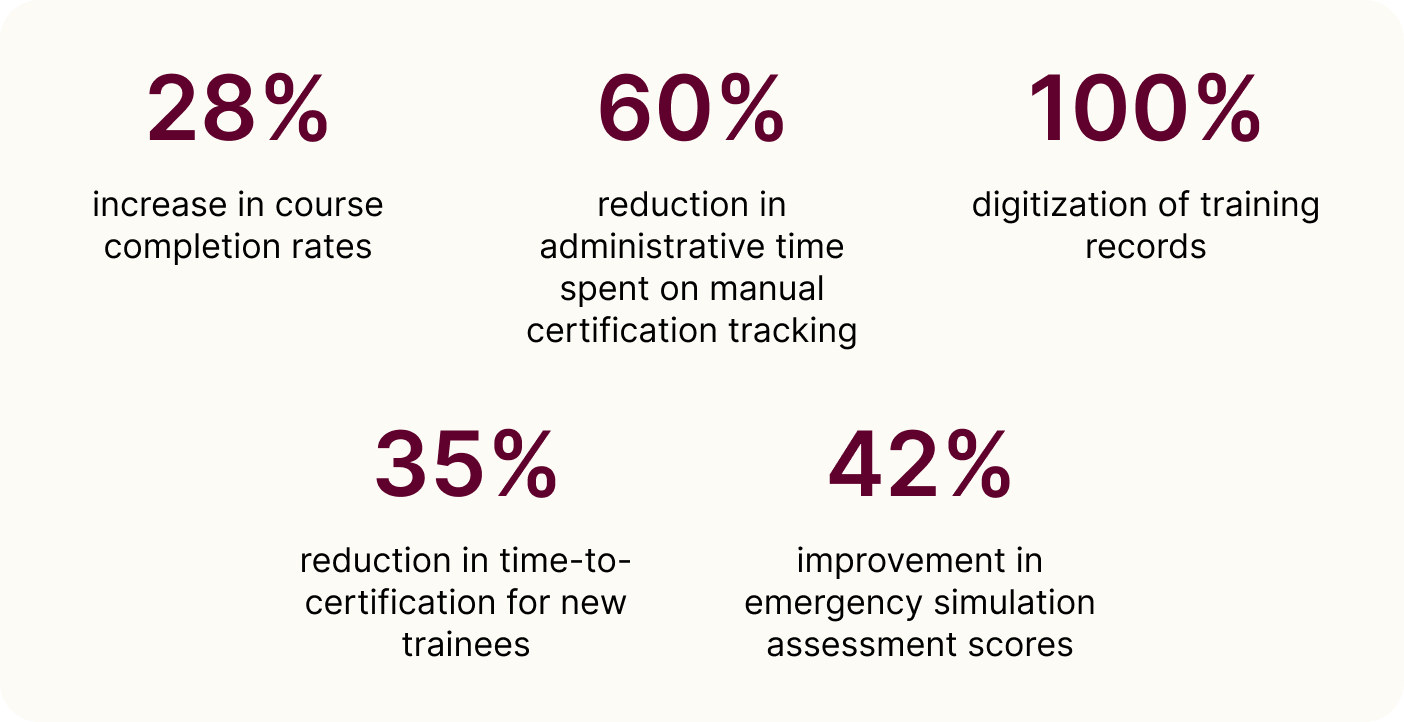
Supervisors report improved visibility into competency gaps and stronger preparedness in emergency drills.
While maternal mortality reduction is a long-term outcome indicator, early evidence suggests improved procedural adherence and increased confidence among trainees during simulated crisis scenarios.
Key Performance Indicators (KPIs)
The next 24-month expansion phase will measure:
Output Indicators
- Number of maternal health workers enrolled.
- Percentage completing full competency pathways.
- Number of emergency simulations completed per trainee.
- Certification issuance rate.
- Regional training centers onboarded.
Outcome Indicators
- Reduction in competency gaps identified during audits.
- Improvement in emergency scenario response time (simulation-based).
- Retention rate of trained maternal health workers.
- Reduction in procedural deviations during supervisory assessments.
System-Level Indicators
- Percentage of training data securely digitized.
- Recertification compliance rate.
- Cost per trained health worker compared to traditional in-person-only model.
24-Month Scale Plan
The expansion will extend the platform to additional regional community centers, focusing on rural and semi-urban maternal health networks.
Projected scale:
- 600–800 maternal health professionals trained.
- 10 regional centers connected to centralized oversight.
- Local trainers certified in digital delivery facilitation.
- Continuous content localization and adaptation.
The objective is institutional resilience - not a one-time program.
Budget Narrative (24 Months)
1. Platform Infrastructure & Licensing - €180,000
Includes LMS hosting, security architecture, mobile optimization, multi-site administration, and technical support.
2. Content Digitization & Simulation Development - €120,000
Conversion of maternal health curriculum into structured modules and interactive emergency simulations adapted for local protocols.
3. Training of Trainers (ToT) & Capacity Building - €90,000
Workshops for regional facilitators, supervisory training, and local technical onboarding.
4. Monitoring, Evaluation & Data Governance - €60,000
Impact measurement, compliance audits, data security assessments, and reporting framework.
5. Local Implementation Support & Field Coordination - €100,000
Regional rollout coordination, stakeholder engagement, translation/localization support.
Total Estimated Budget (24 Months): €550,000
Cost per trained health worker (projected): €690-€920 depending on scale achieved.
Compared to traditional workshop-only models, this approach reduces long-term per-trainee cost while increasing measurable competency outcomes.
Sustainability Strategy
The system is designed to transition toward partial local co-financing through:
- Government health partnerships.
- Tiered certification programs.
- Integration with public health workforce development initiatives.
Digital infrastructure ensures marginal cost decreases as scale increases.
The more centers connected, the stronger and more affordable the system becomes.
Why This Investment Matters
Maternal health outcomes depend on professional readiness.
Workshops inspire.
Systems sustain.
This initiative demonstrates that digital learning infrastructure can:
- Standardize clinical competencies.
- Strengthen emergency preparedness.
- Reduce compliance gaps.
- Enable rural scalability.
- Improve institutional accountability.
Investing in training infrastructure is investing in safe births.
When Hana faces her next emergency case, preparation is no longer theoretical. It is practiced, measured, and validated.
And in maternal health, preparedness saves lives.

Related posts
Here’s what else you might be interested in.