How Dubai Health Authority Transformed Professional Learning with a Modern LMS

Where the Story Began
When the Dubai Health Authority reviewed its training ecosystem, it became clear that the issue was not the absence of learning. Courses existed. Certifications were required. Workshops were conducted. Yet everything operated in parallel streams.
Each hospital and clinic maintained its own processes. Compliance tracking relied heavily on manual updates. Onboarding varied from department to department. Leaders lacked a single, reliable view of competence levels across the organization.
In a healthcare system, fragmentation is not simply inefficient - it carries risk.
DHA needed a unified, structured solution that could elevate professional competence while strengthening governance.
Building Structure Where There Was Complexity
The transformation began by redesigning learning as a journey rather than a collection of disconnected courses.
When a nurse now joins DHA, the experience begins even before the first working day. Required documentation is uploaded and verified digitally. Mandatory compliance modules are assigned automatically. Over the first month, the nurse progresses through clearly defined clinical standards tailored to the department. As weeks pass, simulation-based exercises introduce real-life case scenarios. Competence is validated step by step.
The same logic applies to physicians, allied health professionals, and administrative staff. Each role follows a structured pathway aligned with responsibilities and regulatory requirements.
This clarity alone reduced onboarding time by up to thirty-four percent. New professionals entered clinical environments better prepared and more confident.
Turning Learning into Practice
Another shift occurred in how knowledge was delivered.
Long, static compliance courses were replaced with focused, interactive microlearning sessions. Instead of passively reading guidelines, healthcare professionals began engaging with realistic patient cases, infection control decisions, emergency response simulations, and equipment handling scenarios.
Learning became practical. Decisions had consequences inside the simulation. Immediate feedback reinforced correct actions and corrected mistakes.
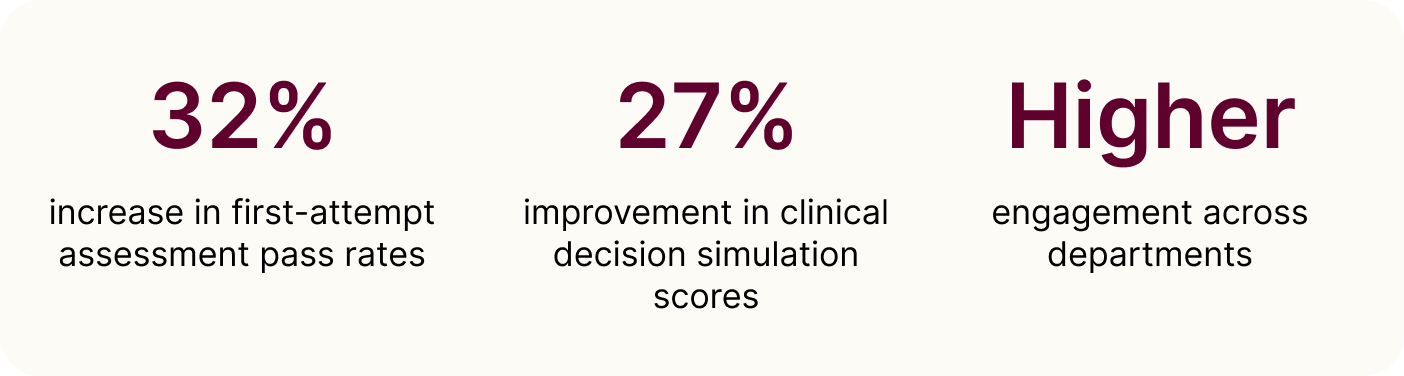
The impact was measurable. First-attempt assessment success increased by thirty-two percent. Performance in scenario-based evaluations improved significantly. Engagement levels rose because learning felt relevant rather than procedural.
In essence, staff were no longer just completing modules - they were practicing clinical judgment in a safe digital environment.
Result:
Replacing Manual Effort with Intelligent Automation
Before the LMS, compliance management required constant follow-up. Certification expiry dates were tracked in spreadsheets. Department heads spent valuable time reconciling training records. Audit preparation could take weeks.
After implementation, the process became automated and transparent.
Licenses are now monitored in real time. When a certification approaches expiration, the system automatically assigns the required renewal training and notifies the professional. CPD hours accumulate automatically within personal dashboards. Leadership can instantly view compliance levels across departments. Audit reports can be generated within minutes.
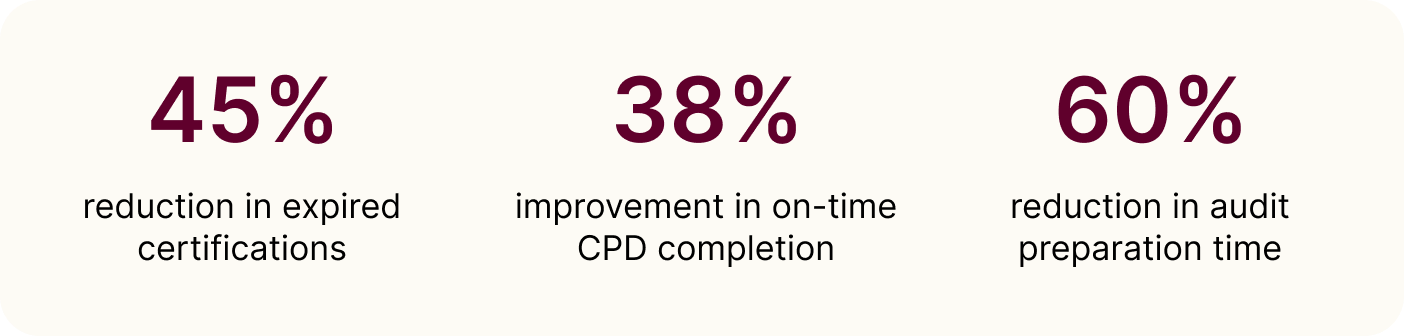
Within the first year, expired certifications dropped by nearly half. On-time CPD completion increased dramatically. Audit preparation time decreased by more than half.
The organization shifted from reacting to compliance issues to preventing them.
Result:
What This Meant for DHA
Over twelve months, the LMS became more than a digital training platform. It evolved into a governance backbone.
Professional competence became visible and measurable. Onboarding became consistent across facilities. Leaders gained actionable insight into skill gaps and training effectiveness. Staff developed stronger confidence in their readiness to perform.
Most importantly, learning aligned directly with operational excellence and patient safety.
Within 12 months:
- Onboarding time reduced by up to 34%.
- Compliance rates increased to 92%+.
- Certification lapses reduced by nearly half.
- Department leaders gained real-time visibility into competency gaps.
The Outcome
Through structured digital pathways, simulation-based microlearning, and automated certification tracking, DHA created a scalable professional development ecosystem.
The measurable results were clear: faster onboarding, higher compliance rates, stronger knowledge retention, and improved clinical decision-making.
In healthcare, competence is not theoretical. It affects real lives. By modernizing its learning infrastructure, DHA ensured that professional development directly supports quality of care.
And that is where technology demonstrates its true value.

Related posts
Here’s what else you might be interested in.